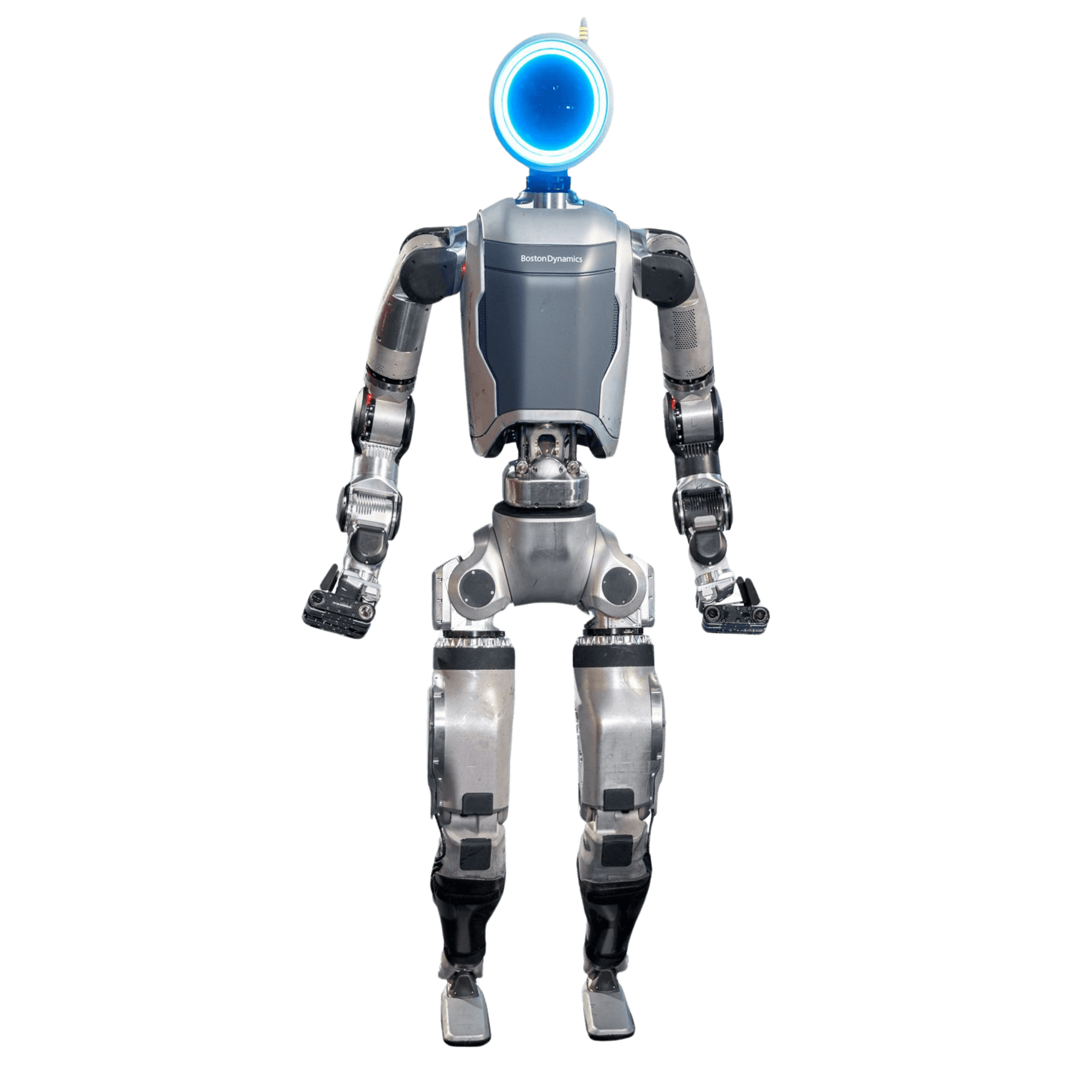
Boston Dynamics' electric Atlas represents the fifth generation of the company's flagship humanoid, unveiled in April 2024 following the retirement of the hydraulic version after over a decade of development. The production-ready version debuted at CES 2026, with initial pricing near $420,000 positioning Atlas as a premium automation option for enterprises.
The electric Atlas features 56 degrees of freedom with fully rotational joints, a reach extending to 7.5 feet, and the strength to lift 110 pounds. Standing approximately 1.5 meters tall and weighing 89 kg, Atlas achieves 85-90% electrical-to-mechanical efficiency with sub-10 cm foot-placement precision. Custom actuators manufactured using advanced 3D printing in titanium and aluminum provide components both stronger and lighter than traditional methods. The robot operates at temperatures from -4°F to 104°F.
Powered by the NVIDIA Jetson Thor platform delivering 800 teraflops of AI performance, Atlas runs advanced models for sensor fusion, perception, control, and real-time decision-making. The robot features LiDAR, stereo and RGB cameras, and depth sensors for comprehensive environmental awareness. Three control modes, autonomous, teleoperated, or tablet interface, provide deployment flexibility. Atlas can autonomously navigate to charging stations and swap its own batteries when power runs low.
All 2026 deployments are fully committed to Hyundai's Robotics Metaplant Application Center and Google DeepMind. Hyundai plans to build a US robotics production facility capable of producing 30,000 Atlas robots annually by 2028, with initial deployment at their Savannah, Georgia manufacturing site. The automotive giant intends to use Atlas in car plants by 2028 for parts sequencing, with responsibilities extending to component assembly by 2030.