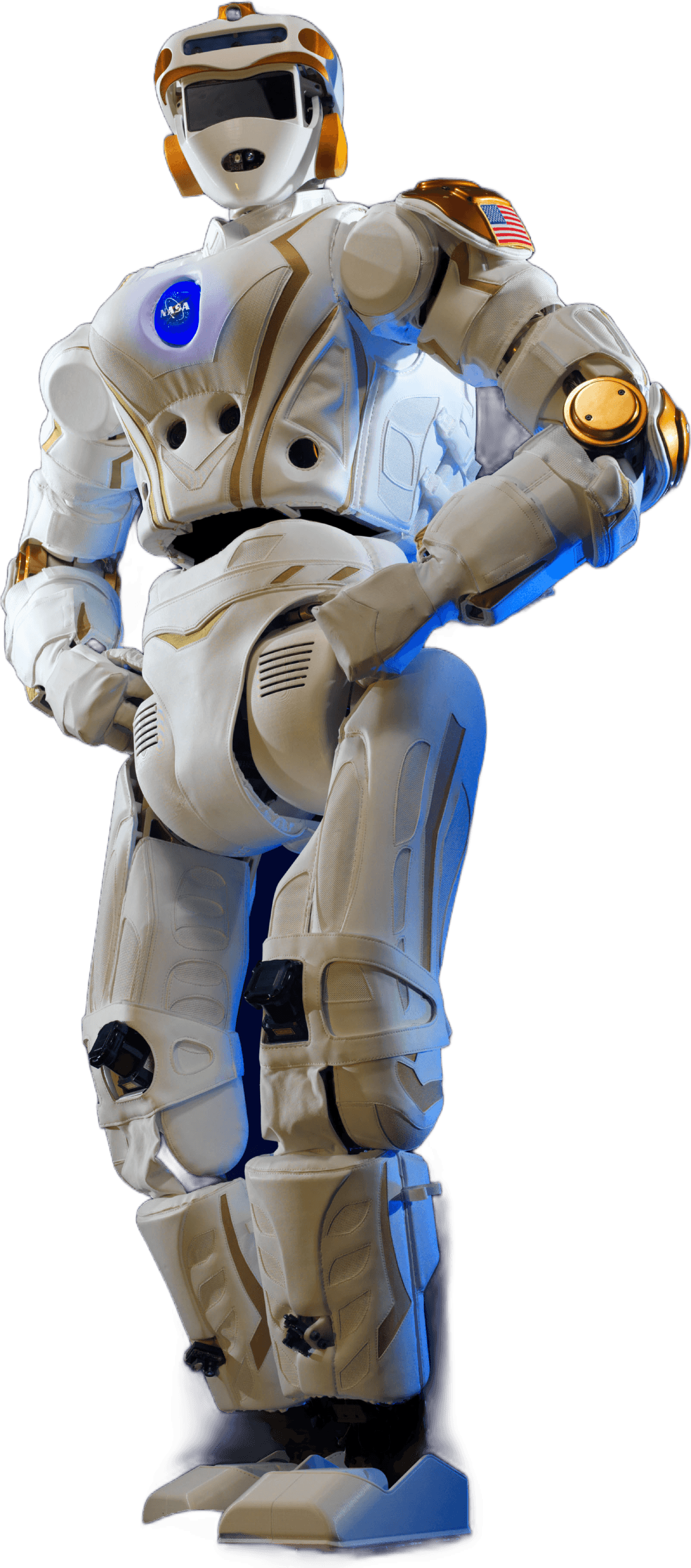
NASA's Valkyrie (R5) represents the space agency's most advanced humanoid robot, designed for operating in degraded or damaged human-engineered environments, whether on Earth during disasters or on other planets preparing for human arrival. Conceived, designed, and built in under 12 months starting October 2012, Valkyrie demonstrates NASA's rapid development capability.
Standing 187 cm tall and weighing 129 kg, Valkyrie features 44 degrees of freedom distributed across a sophisticated series-elastic actuator architecture. The 3-DOF waist uses parallel linear actuators for pitch and roll atop a rotary actuator for yaw. Each leg follows a yaw-roll-pitch-pitch-pitch-roll configuration with series-elastic actuators throughout. Arms feature five rotary and two linear actuators.
The simplified humanoid hands include 3 fingers and thumb with six actuators per forearm. A 1.8 kWh dual-voltage battery provides roughly one hour of autonomous operation. Three Intel Core i7 Express CPUs handle processing, connecting via Ethernet or WiFi. LIDAR constantly scans surroundings from behind the infrared-transparent faceplate.
NASA delivered upgraded Valkyrie units to robotics labs in the US and Europe for collaborative research. The robot cost approximately $2 million per unit. Valkyrie's mission extends beyond immediate utility. The platform advances humanoid capabilities needed for space exploration where robots must work alongside astronauts or precede human missions to hostile environments.