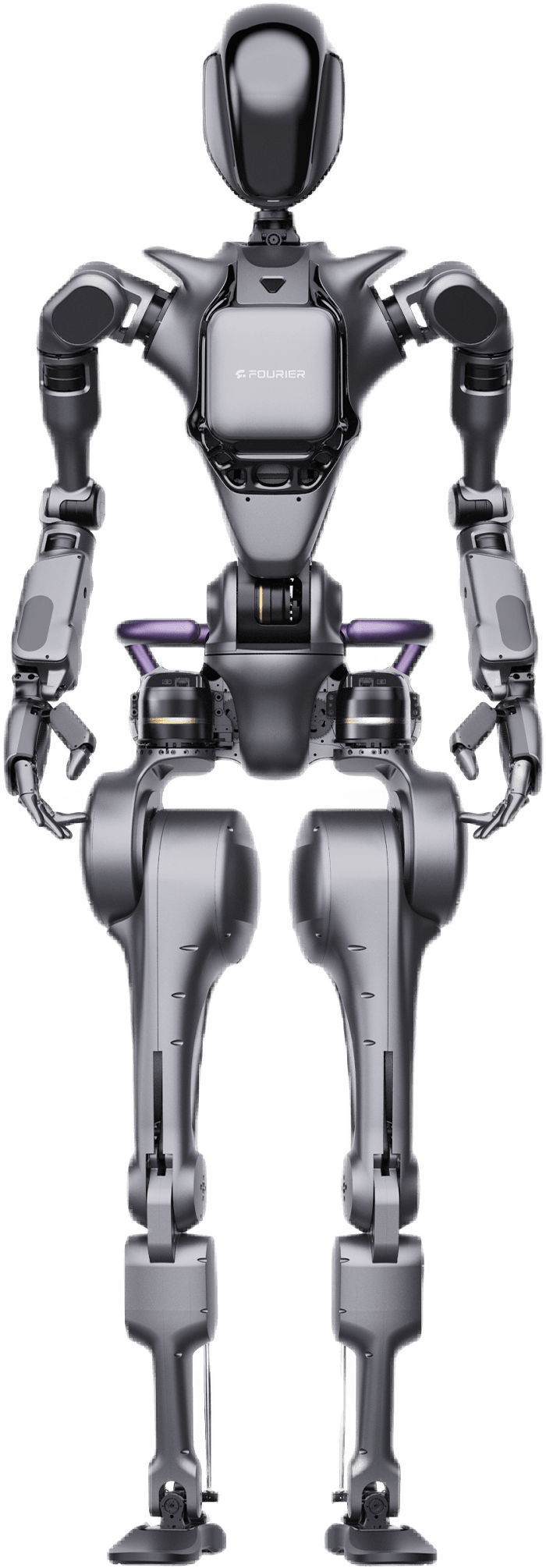
Fourier Intelligence's GR-1 emerges from the company's unique background in rehabilitation robotics, bringing expertise in human biomechanics to general-purpose humanoid design. Founded in 2015, Fourier has manufactured exoskeletons and rehabilitation devices deployed in hundreds of hospitals across more than 10 countries. This experience that directly influences GR-1's focus on safe human interaction.
Standing 165 cm tall and weighing 55 kg, GR-1 features 40 degrees of freedom with hip joint peak torque of 300 Nm. The robot walks at speeds up to 5 km/h while carrying 50 kg payloads. Each hand provides 11 degrees of freedom for secure grasping of various objects, reflecting the manipulation requirements common in rehabilitation scenarios.
GR-1's design emphasizes a highly bionic, human-sized body with an extensive library of predefined motions for twisting, squatting, and gripping. Large language model integration enables task automation and intuitive human-robot conversation. Built-in emotional systems and high-resolution displays support the social interaction crucial for healthcare applications.
Fourier trains GR-1 using NVIDIA Isaac Gym, running thousands of parallel simulations to develop robust locomotion and manipulation skills. This simulation-first approach accelerates skill development while reducing the risks and costs of physical testing. The company's rehabilitation heritage influences applications. GR-1 has been tested assisting therapists by guiding patients through range-of-motion exercises and providing partial weight support.
With projected costs of $150,000 to $170,000, GR-1 targets both industrial and healthcare markets. In 2024, Fourier split into two units: Fourier for general-purpose robotics and Fourier Rehab for rehabilitation-specific innovations, allowing focused development for each market segment.